Table Of Content
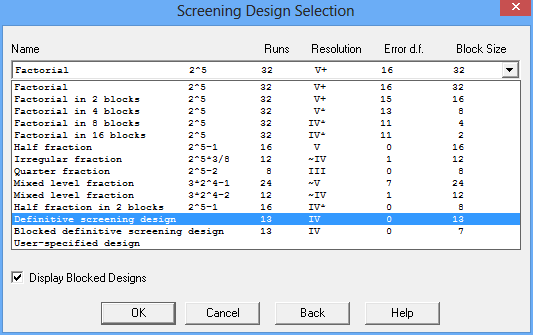
In definitive screening designs, no square terms are aliased with terms for main effects. The definitive screening designs provide a way to both identify the most important factors and optimize the response variable using a single set of experimental runs. As such, they are an economical solution for experimenters whose final goal is process optimization. In Box, Hunter and Hunter, they proceed by constructing a 16-run 25-1 fractional factorial design. Each factor is run 8 times at a low level and 8 times at a high level. The design is resolution V, meaning that there is no confounding amongst the main effects and the two-factor interactions.
Databases
As we shall see, a definitive screening design exists in 13 runs that provides an alternative to the fractional factorial design. We'll also discuss the strengths and weaknesses of the 2 design choices. Wow, DSDs, with their desirable combinatorial structure, look extremely useful and resource efficient alternative designs to the classical 2-level screening designs we described above. Since both authors of DSDs are leading practitioners and proponents in the optimal design of experiments, it might not come as any surprise to learn that DSDs in fact started life as alias-optimal[2] designs. Perhaps at first it would therefore appear fascinating that DSDs have such a balanced, practical and appealing combinatorial structure. I use the correlation cell plot here to show why definitive screening designs are definitive.
Studios have specific requirements
Formulation characteristics and in vitro release testing of cyclosporine ophthalmic ointments - ScienceDirect.com
Formulation characteristics and in vitro release testing of cyclosporine ophthalmic ointments.
Posted: Sun, 10 Jun 2018 07:00:00 GMT [source]
The traditional approach to designing experiments is to start with a screening design to screen out the important main effects, then transform this screening design into a resolution IV design to study the interactions. Constructing definitive screening designs using conference matrices. Thanks to that, no two factors interaction will be aliased with any main effect in a DSD, although two factor interactions are (partially) confounded with one another. In DSDs, second order effects are also partially confounded with two factor interactions and with one another, but main effects are protected against any confounding. Figure 2 shows the cell plot for the fractional factorial design. DSDs may be considered as a multipurpose, very flexible type of DoE.
Screening Designs
This might lead an investigator, using a classical 2-level screening or fractional factorial design, to falsely screen out a factor as having no (linear) effect when in fact it is important to the process. The ability to estimate quadratic terms for and attribute curved as well as linear behaviour to the factors under study. Besides definitive screening designs, 2 common types of screening designs are Plackett-Burman designs and resolution III fractional factorial designs. Both Plackett-Burman designs and resolution III fractional factorial designs are 2-level designs. The most notable way that definitive screening designs differ from standard designs is that all the factors are numeric and tested at three levels. A second distinctive feature of a definitive screening design is that it is a self-foldover.

How are definitive screening designs different from 2-level designs?
For all open access content, the Creative Commons licensing terms apply. The Statgraphics Blog is designed to share knowledge and ideas amongst all members of the Statgraphics community. We welcome your comments and suggestions regarding the topics posted.
If they’re not stored inside, make a screened outdoor area (preferably in the rear yard not directly facing a unit's window). You are generally required to have three 32-gallon toters for a single-family home adding one unit. For multi-family homes with 3 or more units, you may be required to add a fire alarm and sprinkler system to your ground floor for Local program ADUs.
Definitive Screening Designs are three level designs that enable one to study second order, quadratic effects. However, with only one center point and a number of runs that is much smaller than in a standard response surface design, the probability to detect significant quadratic terms (the power level) is certainly not as high. The engineer refines the model further and finds that the CE interaction and the GG square term remain statistically significant when the model includes those terms. The engineer decides that factors B and F do not have large main effects and are not likely to be in any large 2-way interactions. The engineer decides that the result of the screening experiment is that the engineer can exclude factors B and F in further experiments to understand the process better.
In order to maintain the visual interest of a neighborhood, it is important that the design of new buildings and renovations to existing buildings be compatible with nearby buildings. A single building out of context with its surroundings can be disruptive to the neighborhood character and, if repeated often enough, to the image of the City as a whole. With a single center point, only quadratic effects that are strong enough will become noticeable. Anyway, if the objective is to identify the optimum, the experimenter is likely to be interested only in large curvatures that markedly differ from a simple linear model. In San Francisco, the Fire Department is responsible for R-2 buildings.
Teaching Design of Experiments to chemists: lessons from Imperial College London - Chemistry World
Teaching Design of Experiments to chemists: lessons from Imperial College London.
Posted: Thu, 09 Apr 2020 14:32:26 GMT [source]
How are definitive screening designs different from resolution III screening designs?
The fold-over structure of DSDs results in orthogonal main effects, and main effects are also orthogonal to all second-order effects. The colourful correlation cell matrix below emphasises these particularly desirable properties. Desirable, because screening designs are primarily intended to support first order models, but there is often concern that responses might exhibit strongly curved behaviour over the factor ranges.
If you have a single-family home and are adding 1 unit, your property will remain an R-3. These rules define the occupancy codes of our homes and buildings. They can be installed after construction and do not need to be included on the plans prepared for the City. One effective way to do that is to make sure that if fires start, they can’t spread. Habitable rooms must have natural ventilation that’s at least 4% of the floor area.
Definitive screening designs are a type of resolution IV design. In resolution IV designs, main effects are not aliased with any 2-way interactions. Because resolution III designs have relatively few runs when you compare them to more detailed designs, resolution III designs are common screening designs. However, in resolution III designs main effects are aliased with 2-way interactions.
The DSD for the 6 continuous Esterification parameters is displayed below. Without running additional experiments, it is possible to get a reasonable estimate of the response surface in any 3 factors. Notice that the VIFs are relatively low, so the fitted model could well be used for process optimization. To fit such a model after running a 2-level fractional factorial design, additional experiments would need to be done, such as adding star points to create a central composite design.
We require that a licensed design professional sign and stamp most ADU plans. Follow these guidelines to create ADU plans that meet City codes. Opening a business, renovating or expanding a home, or considering a construction project? It almost sounds like what you've got is model already...and now you'd like to simulate that model 1000 times. You don't need JSL to do that...just specify the number of simulations within the workflow of the simulator and you'll get a distribution of Y's.
In the second pareto chart, the engineer notices that the effects for a 2-way interaction (CE) and a square term (GG) cross the reference line, although the terms are not in the model. Finally, by adding some axial and center points, this design can be converted into a response surface design. The importance of concentration is now evident through the term "EE", which represents its quadratic effect.
Accessory dwelling units (ADU) must meet City requirements that keep buildings safe and neighborhoods livable. Table 1 Definitive screening design for eight three-level factors. Because B was the smallest term in the model on the Pareto chart, the engineer excludes B from the model.
[3] By fitting a model including all the MLEs and excluding the intercept. The predicted Y values (YME) will be used to identify the MLEs in part 1 and the orthogonal, or uncorrelated, residual Y values (Y2nd) used to identify the 2nd order effects in part 2. The most notable feature of this cell plot is that all the cells are either pure blue or red. Every pair of columns is either completely uncorrelated or completely confounded.


No comments:
Post a Comment